Home / Products / Beans, Peas & Lentils / Split Peas
Wholesale ingredient • Documentation support • Custom processing
Split Peas
Wholesale supply for Split Peas built for manufacturing—consistent specs, documentation support, and flexible formats (green/yellow; screened sizes; milling options program-dependent) for USA & Canada buyers.
Ingredient overview
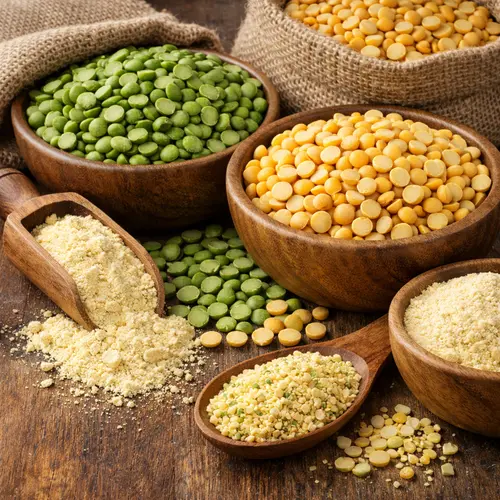
Split peas are field peas that have been dehulled and split for faster cooking and easy hydration in manufacturing. They’re widely used in soups and prepared foods, and increasingly in plant-forward formulations where pulses support protein positioning, fiber content, and texture. Split peas can be supplied as whole splits (standard) or further processed (screened sizes, milled flour/powder) depending on the program.
- Common types: green split peas, yellow split peas
- Typical profile: mild, slightly sweet “pea” flavor; yellow can read a bit more neutral in some applications
- Functional role: thickening, body/texture, protein & fiber contribution
- Common uses: soup bases, savory blends, extruded snacks, pulse-based flours (program-dependent)
If your product requires uniform hydration and predictable viscosity, ask about screened sizes and milling options.
Types & formats
Select the type and format that best matches your process—kettle cooking, retort, dry blending, or extrusion. If you’re replacing an existing ingredient, tell us what you use today and we’ll match it.
Green split peas
- Best for: traditional split pea soup profiles and green-toned bases
- Flavor: classic pea note; can be more “pea-forward” in some finished products
- Appearance: green/yellow-green split interiors
Often selected when the product expects a “split pea” identity.
Yellow split peas
- Best for: neutral bases, sauces, and applications where color control matters
- Flavor: mild pea profile; commonly used in blends
- Appearance: pale yellow split interiors
Often used in plant-forward products where a neutral canvas is helpful.
Processed formats (program-dependent)
- Screened sizes: improves uniform cooking and hydration predictability
- Cracked/grits: faster hydration; used in certain soups and snacks
- Flour/powder: used in extrusion, baking, and protein-forward formulations
Custom processing depends on volume, lead time, and specification feasibility.
Common formats (quick list)
If you need a specific particle distribution or milling spec, include it in your request (or share your current spec sheet).
Typical specifications (guidance)
Specifications vary by source, crop year, and processing program. Use this as a planning guide and request the current spec sheet/COA for your selected option.
| Parameter | What it impacts |
|---|---|
| Type (green vs yellow) | Finished product color and flavor profile; affects consumer expectations in soup and prepared foods. |
| Size / screen | Cooking uniformity, hydration rate, and consistency in kettle/retort processes; helps reduce over/under-cooked variance. |
| Split integrity | Breakage level can influence dust, yield, and appearance; also impacts blending and conveying behavior. |
| Moisture | Storage stability and flow in bulk handling. Lower moisture generally supports longer shelf stability and reduced clumping risk. |
| Foreign material controls | Screening and cleaning programs reduce risk. If you have internal FM targets, include them in your quote request. |
| Micro targets | Depends on your product category and process (ready-to-eat vs cooked). Request current limits based on program and use case. |
| Milled specs (if applicable) | Flour/powder particle distribution affects extrusion behavior, hydration, and finished product texture. |
| Certifications (optional) | Organic/non-GMO/kosher documentation availability varies by program and lot. |
Applications
Split peas are used for thickness, body, and protein-forward positioning. Below are common manufacturing uses and the formats typically chosen.
Soups & ready meals
- Traditional split pea soup bases
- Retort soups and prepared meal components
- Dry soup mixes and instant meal sachets
Often used: screened split peas; cracked/grits for faster cook (request).
Plant-forward foods
- Veggie burgers and patties (binder/body)
- Protein-forward fillings and savory bases
- Pulse-inclusive sauces and dips
Often used: milled flour/powder or smaller particle formats (program-dependent).
Extruded snacks & blends
- Puffed and extruded pulse snacks
- Composite flours for baking mixes
- Dry blends for seasoning and base mixes
Often used: pea flour/powder with defined particle distribution.
Choosing the right format (fast guide)
Quality & documentation support
Documentation commonly requested
- COA: lot-linked results for receiving release
- Specification sheet: grade definition, quality parameters
- Allergen statement: supports label review and QA programs
- Lot traceability: production planning support (as available)
Documentation availability varies by origin and program.
Manufacturing support
- Spec matching: replace current split peas with minimal process change
- Screen selection: improve cook uniformity and line consistency
- Format guidance: splits vs grits vs milled options based on application
- Receiving alignment: coordinate lot records for QA release workflows
Share your internal QA checklist to speed qualification.
Label & claims (general)
- Organic/non-GMO programs may be available (documentation required).
- Pulse ingredients support plant-forward and protein positioning.
- Micro targets should be aligned to your process (dry mix vs cooked).
For claim-critical products, request the current documentation set before finalizing labels.
Handling & storage (general guidance)
Split peas are a dry pulse ingredient; good storage and handling preserve flow and help maintain consistent cooking performance.
Storage
- Store in a cool, dry area away from moisture and strong odors.
- Keep packaging sealed to reduce moisture pickup and dusting.
- Rotate inventory using FIFO and record lot codes.
On the line
- Use appropriate screening/inspection steps based on your QA program.
- Minimize drop heights and aggressive conveying to reduce breakage.
- If cooking, standardize soak and cook parameters for consistent viscosity.
Cooking performance
- Hydration rate varies with size and crop; screened sizes improve repeatability.
- Overcooking can increase breakdown and viscosity; undercooking can leave chalky texture.
- Run pilot batches when changing suppliers/programs.
How to request a quote (fast)
The more detail you share, the more accurate the pricing and lead-time guidance will be—especially if you need screened sizes or milled formats.
-
Select type & format
Green or yellow; split peas vs screened sizes vs flour/powder. -
Share requirements
Organic/non-GMO/kosher needs, QA targets, and any FM controls. -
Confirm volume & destination
Order size, annual forecast, and USA/Canada delivery region.
Quote checklist
- Type: green / yellow split peas
- Format: standard splits / screened size / grits / flour / powder
- Screen target: if applicable, specify or “match current”
- Certifications: organic / non-GMO / kosher (if required)
- Packaging: bags / totes (preference)
- Volume: per order + annual forecast
- Destination: USA/Canada region
- Application: soup, ready meal, extrusion, flour blend
If you already have a spec sheet (or cook time target), paste it as-is and we’ll match the right program.
Example message (copy/paste)
Use this template in your quote form or email:
Ingredient: Split Peas
Type: Green / Yellow
Format: standard splits / screened / grits / flour / powder
Screen target: ____ (or “match current”)
Certifications: Organic: Yes/No • Non-GMO: Yes/No • Kosher: Yes/No
Packaging: bags / totes (preferred)
Volume: ___ lbs per order • annual forecast ___ lbs
Delivery: USA/Canada • region: ____ • needed by: ____
Application: soup / ready meal / extrusion / flour blend
Tip: If your main concern is cooking consistency, share your target cook time and viscosity outcome.
Request a quote for Split Peas
Share target specs (organic/kosher), type (green/yellow), format, annual volume estimate, and delivery region (USA/Canada). Include your application so we can recommend the best-fit format.
Request Pricing Request DocumentationIf the form is long, prioritize: Type, Format, Volume, Destination.
FAQ
Answers below are general guidance. For program-specific details, request current documentation with your quote.
Do split peas cook faster than whole peas?
Generally, yes. Split peas are dehulled and split, which typically reduces cooking time compared to whole peas. For manufacturing, screened sizes can further improve hydration and batch-to-batch repeatability.
Green vs yellow split peas—how do I choose?
Choose green when you want classic “split pea soup” identity and green-toned color. Choose yellow for a more neutral base or where color control is important. If you share your end product and color expectations, we can recommend the best fit.
Can you provide pea flour or powder?
In some programs, yes—milled formats may be available depending on volume and specification. If you need flour/powder, include particle targets and application (extrusion/baking/blends).
Do you support organic programs?
Where available, organic programs can be supported. Include your labeling requirement and destination so we can confirm availability and documentation.
Do you ship to both the USA and Canada?
Yes. We support USA and Canada buyers and can coordinate documentation needs for receiving and QA workflows.