Wholesale ingredient • Documentation support • Custom processing
Mulberries (white, black)
Wholesale supply for Mulberries (white, black) with consistent specs, food safety documentation, and flexible formats for USA & Canada buyers—ideal for inclusions, snacks, bakery, and dry blends.
Note: White and black mulberries can differ in color intensity and sensory profile; the best option depends on your finished product targets. Documentation availability varies by origin and program.
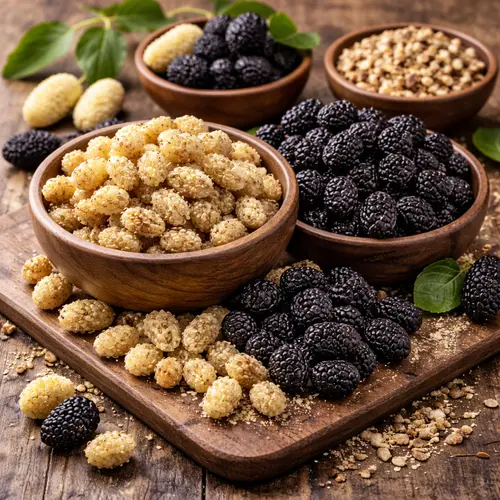
Why manufacturers use mulberries
Mulberries are used for naturally sweet fruit notes, chewy texture (whole fruit), and color influence (especially darker variants), with strong appeal in “better-for-you” snack and bakery concepts.
- Whole fruit inclusions for visual appeal and texture
- Pieces/granules for controlled distribution in mixes
- Powder for flavor and color contribution (application dependent)
What we support
Documentation and sourcing support for procurement, QA, and R&D teams.
- COA & specification sheet support
- Lot documentation and traceability
- Custom processing evaluation (cuts/sieves)
Best-fit customers
Ideal for teams who want consistent inclusions at scale.
- Snack & bar manufacturers
- Bakery, cereal, and granola producers
- Brands and co-packers (USA/Canada)
White vs black mulberries (selection guide)
The right choice depends on your product’s sensory and appearance requirements. Below is a practical guide to differences buyers frequently consider. Final performance depends on the specific lot, processing, and format.
White mulberries
- Appearance: lighter color; tends to blend visually into granola, trail mix, and bars.
- Flavor: often perceived as sweet and mild; complements vanilla, coconut, oat, and nut profiles.
- Use cases: inclusions where you want sweetness without strong color impact.
- Formats: commonly requested as whole berries and pieces; powders may be program dependent.
Black mulberries
- Appearance: deeper color; may influence finished product color or create contrast as an inclusion.
- Flavor: often described as richer and more berry-like; can complement cacao, spice, and berry blends.
- Use cases: products where darker fruit inclusion is desired for contrast or color contribution.
- Formats: whole and pieces commonly requested; powders/granules dependent on processing availability.
If your line is sensitive to clumping or breakage, include your preferred handling and packaging requirements in the request.
Common formats
Availability varies by origin and program. Share your application and we’ll propose a fit.
- Whole dried mulberries (trail mix, bar inclusions, topping)
- Pieces (more uniform distribution in granola, bakery, and inclusions)
- Granules (dry blends, mix-ins, controlled dispersion)
- Powder (dry mixes, flavor systems, color contribution depending on formulation)
- Custom sieve ranges (powders/granules for flow and dosing consistency)
Need a specific cut size, sieve range, or moisture target? Include it in your quote request and we’ll confirm feasibility.
Options & documentation
- Label needs: ask for organic and kosher options (where available)
- QA package support: COA, spec sheet, allergen statement, origin details (program dependent)
- Traceability: lot/production documentation to support internal controls
- Logistics support: paperwork guidance for USA/Canada shipments when needed
Documentation availability can vary by origin and format—request current details with your quote.
Processing notes (what affects performance)
Dried mulberries are commonly selected for inclusion performance. Key factors include moisture/water activity, stickiness, and piece integrity during conveyance and mixing.
- Stickiness & flow: can affect dosing accuracy in inclusions systems and mixers.
- Breakage: whole berries may fracture in aggressive mixing—pieces can improve uniformity.
- Color transfer: darker variants may influence adjacent ingredients in certain products.
- Powder behavior: sieve range impacts dispersion and dusting; packaging matters for shelf stability.
Tell us your application (bar, granola, bakery, chocolate inclusion, dry mix) and we’ll recommend the format that best supports throughput, appearance, and sensory targets.
Typical specification checkpoints
Common checkpoints procurement and QA teams ask about. Exact targets depend on the variant (white/black), chosen format, and origin—request the current specification sheet for the option you’re quoting.
| Ingredient identity | Mulberries (white or black), by format. Program details may include origin/seasonal notes when available. |
|---|---|
| Form / cut | Whole berries, pieces, granules, powder (as applicable); custom sizing may be available. |
| Particle size / sieve | Specified by mesh/sieve for powders & granules; piece sizing for cut fruit. |
| Moisture / water activity | Defined per format to support shelf stability and flow; targets depend on your application. |
| Sensory | Color and flavor intensity can vary by variant and lot; spec alignment improves repeatability. |
| Micro / food safety | Micro targets and test cadence can be documented on COA; requirements vary by customer and use case. |
| Allergen statement | Allergen statement support available; cross-contact controls depend on facility and program. |
| Packaging | Bulk packaging with lot labeling and traceability support (varies by program). |
| Shelf life & storage | Provided by format; storage guidance typically includes cool, dry conditions and sealed packaging. |
For sensitive applications, include your micro limits, foreign material controls, and packaging constraints in the quote request.
Common applications
Mulberries are used to deliver fruit sweetness, texture, and visual appeal across multiple product categories.
Bars & snacks
Whole berries or pieces for chew and sweetness; pairs well with nuts and seeds.
Granola & cereal
Pieces help with distribution and reduce breakage; whole berries for premium visual appeal.
Bakery
Inclusions for cookies, muffins, artisan-style loaves, and fillings.
Chocolate & confection
Inclusions or enrobed pieces; variant choice affects contrast and appearance.
Dry blends
Granules/powder for smoothie blends, functional mixes, and fruit-forward flavor systems.
Foodservice
Bulk supply for standardized recipes and consistent portioning.
How to request the right option
The fastest path to an accurate quote is a complete spec request. Use this checklist.
Select variant + format
White or black; whole, pieces, granules, or powder.
Define size targets
Piece sizing for inclusions; sieve/mesh for powders and granules.
Confirm label claims
Organic? Kosher? Any additional requirements for your brand.
Share volume + cadence
Estimated annual volume and shipment cadence help continuity planning.
List QA documentation needs
COA, spec sheet, allergen statement, origin details, etc.
Tell us ship-to region
USA or Canada; include ship-to state/province if known.
If appearance is critical, tell us whether you need low color transfer or high contrast inclusions.
Packaging, logistics, and supply planning
Wholesale programs are designed to support repeat orders and production planning. Packaging and lead times vary by format and origin, so we’ll confirm availability and options during quoting.
Packaging
Bulk packaging with lot labeling and traceability support. Ask about palletization and receiving constraints.
Handling
Whole fruit may require gentle handling to reduce breakage; pieces/granules can improve line consistency.
Continuity
Share forecasts to support continuity planning and reduce variability across runs.
For high-volume programs, include forecast windows (6–12 months if available) and any seasonal promotion spikes.
Related categories
Browse categories where this ingredient is commonly sourced:
FAQ
Quick answers for procurement, QA, and R&D teams.
MOQs depend on the variant (white/black), format (whole/pieces/powder), and whether custom processing is required. Share your target specs and expected volume and we’ll respond with options.
Yes. Where available, we can quote organic and conventional options so you can compare cost, labeling, and continuity.
White mulberries are often milder in color and commonly used when you want sweetness with minimal visual impact. Black mulberries typically have deeper color and can create contrast or influence finished product appearance more strongly. The best choice depends on your application, format, and sensory targets.
Common documents include a Certificate of Analysis (COA), specification sheet, allergen statement, and country of origin details. Documentation availability varies by origin and format.
Custom processing may be available depending on the program and volume. Share your target cut size, sieve range, moisture needs, and application so we can confirm feasibility.
Send the variant (white/black), format (whole/pieces/granules/powder), any size or sieve targets, label claims (organic/kosher), estimated annual volume, delivery region, and your QA documentation checklist. If you have a target spec sheet, attach it.
Have a specific requirement (micro limits, foreign material controls, packaging, or shelf-life targets)? Add it to your request.
Request a quote for Mulberries (white, black)
Share target specs (organic/kosher), variant (white/black), format (whole/pieces/granules/powder), annual volume estimate, and delivery region (USA/Canada). If replacing an existing ingredient, include your current specification sheet.
Best details to include
- Variant: white or black
- Format: whole / pieces / granules / powder
- Size: cut size or sieve/mesh range
- Label claims: organic / kosher
- Annual volume + shipment cadence
- Ship-to: USA or Canada (state/province helps)
- QA docs: COA, spec, allergen, origin
Helpful extras (optional)
- Target moisture / water activity
- Line handling notes (breakage/clumping sensitivity)
- Color transfer preference (low vs high contrast)
- Packaging constraints / receiving requirements
- Commercialization timeline
If you’re evaluating multiple dried fruits, list your full basket and target specs in one message to streamline quoting.