Home / Products / Organic Dried Fruit / Dragon Fruit
Wholesale ingredient • Documentation support • Custom processing
Dragon Fruit
Wholesale supply for Dragon Fruit (Pitaya) with consistent specs, food safety documentation, and flexible formats for USA & Canada buyers—popular for vibrant visual appeal in smoothie blends, inclusions, snack mixes, and functional powders.
Note: Color intensity and flavor can vary by variety and processing method. If you have a target appearance in mind, describe it (or share a reference image/spec) in your quote request.
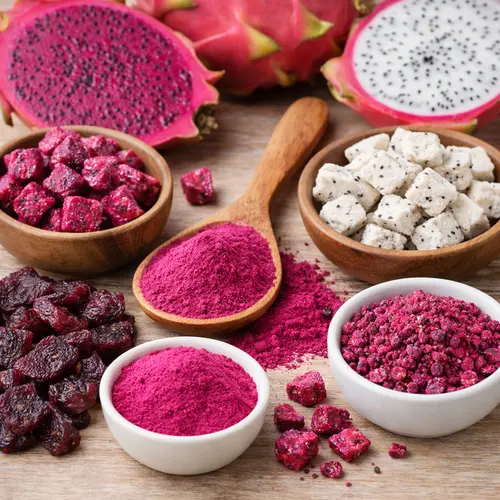
Why brands use dragon fruit
Dragon fruit is often selected for its distinctive look and marketing-friendly appeal. The ingredient can add visible specks, gentle fruit notes, and vibrant color—especially in freeze-dried and powder formats.
- Color & visual identity: standout inclusions and powder blends.
- Format flexibility: slices/cubes for garnish, granules for mixes, powder for dispersion.
- Clean-label positioning: fits many fruit-forward, better-for-you concepts.
- Neutral pairing: complements citrus, berry, mango, coconut, and yogurt-style profiles.
Varieties & what to request (practical)
Buyers typically request dragon fruit by flesh color and format. If you’re not sure, share your end-use and we’ll suggest a fit.
| Option | Typical characteristics | Often used for |
|---|---|---|
| Pink/Red flesh | More vibrant color; popular for powders and visually striking inclusions. | Smoothie mixes, beverage powders, colorful toppings, snack mixes. |
| White flesh | Milder visual impact; subtle fruit notes; can be good for neutral blends. | Granola/cereal inclusions, bakery, fruit blends where color is secondary. |
| Seed/speck definition focus | Emphasizes “speckled” appearance; depends on cut size and processing. | Premium toppings, mix-ins, visible inclusions in pouches or jars. |
Availability varies by origin and season. If you need stable supply, include your forecast volume and target launch dates.
Common formats
Select a format based on your application, mixing behavior, and desired visual impact.
- Freeze-dried slices: garnish, premium topping, high visual appeal.
- Freeze-dried cubes: snack mixes, cereals, pouches (crisp bite).
- Freeze-dried granules: more even distribution in blends and inclusions.
- Dried pieces: chewy inclusions for bakery/snacks (format-dependent).
- Powder: smoothie/blend bases, beverage mixes, flavor & color contribution.
Options & documentation
- Organic and conventional options (where available)
- Kosher options (request current documentation)
- COA & spec sheets for QA and receiving
- Lot traceability and production planning support
- Import / export paperwork support when needed
Documentation availability can vary by origin and format—request current details with your quote.
Specs that matter (what buyers commonly define)
Dragon fruit is frequently purchased for its appearance. These are the spec points that most influence how it performs and how it looks in finished products.
| Spec area | Why it matters | How to describe it |
|---|---|---|
| Cut size / sieve range | Controls distribution, prevents segregation, and defines “speck” visibility. | Target cube size or slice thickness; “through/on” sieve ranges; acceptable fines %. |
| Moisture & texture | Affects crunch vs chew, clumping risk, and shelf behavior. | Moisture target range; desired texture (crisp vs chewy); packaging needs. |
| Powder particle size | Influences dispersion, mouthfeel, and dusting in blending. | Fine vs standard powder; mesh target; acceptable agglomeration. |
| Color expectation | Color impact can vary by variety and processing method. | Red/pink vs white flesh; “vibrant” vs “natural”; reference sample if available. |
| Foreign material controls | Critical for inclusions and ready-to-eat formats. | Your QA thresholds; screening/magnet steps where applicable; inspection requirements. |
| Packaging format | Protects fragile freeze-dried pieces and reduces breakage into fines. | Bulk carton, inner liners, case pack, pallet limits, transit constraints. |
If your product relies on a “showy” inclusion, ask about packaging that reduces transit breakage (to prevent pieces turning into granules).
Common applications
Different formats behave differently in production. Here are typical use cases and what usually matters most in each.
Smoothies & beverage mixes
- Powder for dispersion and color contribution
- Granules for visible fruit specks in dry blends
- Particle size to control mouthfeel and settling
Tell us if you need instant dispersion or if light sediment is acceptable.
Granola, cereal & inclusions
- Freeze-dried cubes for crisp inclusions
- Sieve-defined granules for consistent distribution
- Packaging to reduce breakage and fines
For high-speed lines, tighter cut size specs help maintain consistent fill weights.
Toppings & snack mixes
- Freeze-dried slices for premium visual appeal
- Cubes/granules for mix uniformity
- Moisture protection to maintain crunch
If you pack with humid components, ask about format choices that hold crunch longer.
Packaging & handling (typical)
Freeze-dried fruit is fragile and can generate fines if compressed in transit. Packaging details can meaningfully affect your delivered appearance.
- Cartons with liners: common for freeze-dried pieces and granules.
- Inner bags: helps manage moisture exposure and preserve texture.
- Case pack choices: smaller case packs can reduce compression for delicate formats.
- Pallet configuration: minimize crushing; align with warehouse constraints.
Storage considerations (general)
Most teams preserve quality by protecting fruit from humidity and temperature swings. Storage needs can vary by format and packaging.
- Humidity control: helps maintain crispness for freeze-dried formats.
- Temperature stability: reduces clumping risk in powders and granules.
- FIFO & lot tracking: supports consistent production performance.
- Odor management: store away from strong-smelling ingredients where relevant.
For formal storage requirements (including temperature ranges), rely on the specific documentation and spec sheet for the lot/format you purchase.
How quoting typically works
The fastest path is to align on format and “must-have” specs first, then confirm documentation and lead time.
- Choose a format: freeze-dried (slices/cubes/granules), dried pieces, or powder.
- Define specs: cut size/sieve range, moisture, particle size (powder), and color preference.
- Share volume & destination: annual usage + delivery region (USA/Canada).
- Confirm packaging: case pack and handling needs to protect appearance.
Spec builder (copy/paste)
Use this template in your quote request to reduce back-and-forth.
Format: freeze-dried slices / cubes / granules • dried pieces • powder
Flesh color preference: red/pink • white • either
Target cut size / sieve:
Powder particle size (if powder): fine • standard • mesh target
Texture goal: crisp • chewy • visual inclusion only
Certifications: organic • kosher • other
Allergen needs (declare/avoid):
Packaging: case pack preference, liner requirements, pallet limits
Annual volume estimate:
Delivery region: USA / Canada (state/province)
If you’re unsure which format fits, tell us the application (smoothie powder, granola inclusion, topping) and your priority (color, crunch, piece size).
Related categories
Browse categories where Dragon Fruit is commonly sourced:
Organic Dried Fruit Organic Freeze-Dried Fruit Freeze Dried Dried Fruit
If some category links above don’t exist on your site yet, remove them or replace them with the correct URLs.
Request a quote for Dragon Fruit
Share target specs (organic/kosher), format (freeze-dried vs dried vs powder), cut size/sieve range, annual volume estimate, and delivery region (USA/Canada). If your product depends on a specific color or appearance, include that in your request.
For powders, include whether you need a fine powder for beverages or a standard powder for dry blends. For inclusions, include acceptable fines % and packaging constraints.
Prefer email? Send your specs to contact@atlastradehouse.com.
FAQ
Do you have minimum order quantities (MOQs)?
MOQs depend on format and spec needs (cut size, powder fineness, organic/kosher documentation). Share your volume and destination and we’ll confirm MOQ and lead time options.
Can I request organic and conventional pricing?
Yes. Where available, we can quote organic and conventional options so you can compare cost, labeling, and lead times.
Which format is best for granola or cereal?
Many buyers use freeze-dried cubes or granules for a crisp inclusion and strong visual presence. If you want less breakage, consider granules with a defined sieve range and packaging that limits compression.
Which format is best for smoothies or beverages?
Powder is most common for beverage mixes, though performance depends on particle size and your dispersion needs. Tell us your product type and we’ll suggest a practical powder spec.
What documentation can you provide?
Documentation may include COAs, spec sheets, allergen statements, and lot traceability. Import/export support is available when needed. Availability varies by origin and format—request current details with your quote.
What helps you quote fastest?
Format, flesh color preference, target cut size/sieve range (or powder fineness), certification needs (organic/kosher), annual volume estimate, delivery region, and packaging constraints.
For formal storage requirements and shelf-life guidance, rely on the specific documentation and spec sheet for your requested format/lot.