Home / Products / Freeze-Dried Vegetables & Herbs / Parsley
Wholesale ingredient • Documentation support • Custom processing
Parsley
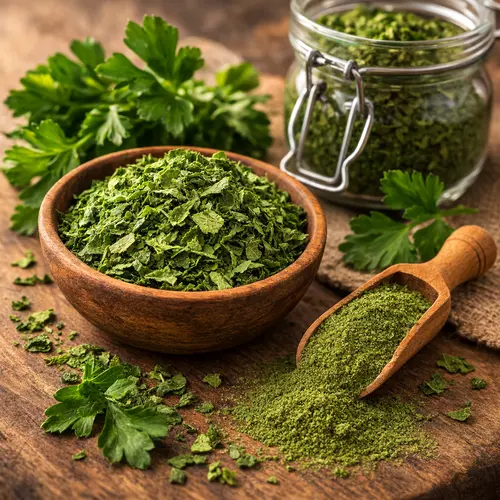
Wholesale supply for parsley with consistent specifications, food safety documentation, and flexible processing formats for manufacturers, brands, and co-packers in the USA & Canada. Typical options include freeze-dried parsley flakes, granules, and parsley powder designed for soups, sauces, seasoning blends, and ready meals.
Why freeze-dried parsley
Selected for bright appearance, fast rehydration, and clean herb notes—useful where visual “green” garnish is important.
How it’s specified
Defined by cut size (flakes/granules/powder), color expectations, aroma, and moisture targets for flow and shelf stability.
Where it performs best
Dry soups, instant meals, seasoning blends, snack applications, sauces, and bakery toppings (application-dependent).
Overview
Parsley is a widely used culinary herb valued for its fresh green appearance, mild herb aroma, and broad compatibility in savory formulations. In manufacturing, parsley is often treated as a “visual ingredient” as much as a flavor ingredient— especially in soups, sauces, and ready meals where a green garnish signal matters to consumers.
- Primary role: garnish appearance, mild herb notes, and aromatic lift
- Common manufacturing goal: consistent color and particle size for uniform distribution
- Format selection: flakes for visible garnish, granules for blending, powders for uniform flavor
- Freeze-dried advantage: fast rehydration and strong visual pop (format dependent)
Practical note: Cut size drives how parsley looks in the finished product and how it feeds through your equipment.
If you share your line (ribbon blender, tumble, auger feed) and target appearance, we can recommend a compatible cut.
What buyers optimize
Parsley sourcing is usually driven by a few practical constraints:
- Color consistency: keep a stable green shade batch to batch
- Aroma profile: clean herb notes without musty/off notes
- Particle size: avoid segregation in blends; ensure consistent dosing
- Dust control: granules vs powder selection based on plant environment
- Rehydration behavior: visible flakes that “wake up” in soups and sauces
- Documentation: COA/spec/allergen/traceability for QA and audits
Common buyer questions
- “Do we need flakes or granules for our soup base?”
- “Can you match our current cut size and color?”
- “Will it clump or bridge in our feeder?”
- “Can you support organic/kosher documentation?”
Common formats & processing options
Format selection depends on appearance, dust control, and how the ingredient behaves in blending and rehydration. Below are common parsley options requested by manufacturers.
Freeze-dried flakes
Visible “leaf” pieces for garnish and rehydrating systems.
- Often used in soups, noodles, and ready meals for visual appeal
- Fast rehydration in hot water applications
- Selected for bright green appearance
- Cut size options (small/medium flakes) depending on program
Granules
Lower dust, improved flow, and more uniform blending.
- Often preferred for seasoning blends and dry mixes
- Reduced powder dust compared to fine milled forms
- Helps reduce segregation in multi-ingredient blends
- Can be screened to target a specific size range
Parsley powder
Uniform distribution and flavor delivery.
- Used where visible flakes aren’t needed
- Useful in sauces, dips, and seasoning systems
- Sieve ranges available to match your process
- Manage moisture pickup to maintain flowability
Custom processing: If you need a specific flake size, granule range, or powder sieve (mesh), include it with your request along with your end use and equipment type.
For soups & instant meals: flakes are often chosen for visible garnish and quick hydration.
If your product uses short cook times, specify “fast rehydration” in your request.
For dry blends: granules can reduce dust and improve blend uniformity.
If you’ve had segregation or bridging issues, describe them so we can recommend a better cut.
Specifications, quality & documentation
Parsley is typically specified by cut size, color, aroma, and documentation requirements. We support documentation-first sourcing to help QA and procurement teams validate materials efficiently.
| Area | What buyers commonly specify | What to include in your request |
|---|---|---|
| Format | Freeze-dried flakes, granules, powder; custom screening options | Your end use and preferred cut size / sieve range |
| Appearance | Color range (green intensity), uniformity, defect limits (spec-dependent) | Visual requirements (garnish vs blend) and any color expectations |
| Aroma & taste | Clean herb aroma, absence of off-notes | Target profile and whether parsley is a primary note or background garnish |
| Moisture & flow | Moisture targets for stability and flowability | Any caking/bridging concerns and your packaging environment (humidity) |
| Food safety docs | COA (lot), spec sheet, microbial parameters (spec-dependent) | Your QA requirements and whether you need pre-ship COA/spec |
| Allergens | Allergen statement and cross-contact notes where available | Allergen restrictions and facility constraints |
| Certifications | Kosher/organic options where applicable | Which certificates are required and whether copies are needed before sampling |
| Traceability | Lot ID and origin documentation where available | Country-of-origin preferences, audit needs, record retention requirements |
Documentation availability: COA and spec sheets are common. Kosher/organic certificates are available where applicable and vary by origin and program—request current details with your quote.
Applications
Parsley is widely used across savory products. The right format depends on whether you need visible garnish, uniform distribution, or dust control.
- Dry soups & instant noodles: freeze-dried flakes for visible “green” garnish and quick hydration
- Seasoning blends: granules for blend uniformity and reduced dust
- Sauces & dips: powder for even distribution and consistent flavor
- Ready meals: flakes or granules depending on visual requirements and process
- Snack seasoning: granules for tumbling systems; control dust and adhesion
- Bakery toppings: flakes as visual garnish (application-dependent)
Dispersion tip: If you need parsley to disperse evenly in liquids, powder can help. If you need parsley to remain visible, flakes are typically the better option.
How to request the right parsley option
Include these details to speed up quoting and reduce trial-and-error:
- End use: soup base, noodle cup, seasoning blend, sauce, ready meal
- Format: flakes vs granules vs powder
- Cut size: target flake size or sieve/mesh range
- Appearance target: visible garnish vs background herb note
- Process: rehydration time, heat exposure, mixing method
- QA needs: documentation package, microbial requirements, screening/metal detection
- Certifications: kosher/organic; allergen restrictions
- Volume & packaging: annual forecast; case/pallet preference
- Destination: USA/Canada delivery region and timeline
Benchmark tip: If you’re replacing a current parsley supplier, share your existing cut size and what you like/dislike (color, hydration, dust, flow). We can match closer on the first quote.
Handling, storage & shelf-life planning
Freeze-dried herbs can be sensitive to moisture pickup. Good storage practices help preserve color and aroma and keep materials free-flowing.
Storage guidance (general)
- Store cool and dry, away from direct light
- Keep packaging sealed to limit moisture pickup
- Avoid strong odors (herbs can absorb odors)
- Use FIFO/lot control for consistent color and aroma
If your facility is high humidity, consider sealed transfer bins for powders and granules.
Manufacturing handling tips
- Choose granules to reduce dust in open blending systems
- Use gentle handling for flakes to reduce breakage
- Confirm screens/metal detection requirements for your line
- Minimize open-air exposure during production runs
If you have feeder bridging issues, describing the equipment helps us recommend a better size cut.
Color retention: Light and oxygen can reduce perceived “green” over time. Sealed packaging and cool storage helps maintain appearance.
Related categories
Browse categories where this ingredient is commonly sourced:
Freeze-Dried Vegetables & Herbs
Looking for blends (parsley + chives + dill) or other herb formats? Include your target blend and usage application.
Request a quote for Parsley
Share format (flakes/granules/powder), cut size or sieve range, certifications (organic/kosher), annual volume estimate, and delivery region (USA/Canada).
Request PricingPrefer email? Write to contact@atlastradehouse.com with subject: Parsley – Quote Request.
FAQ
General guidance—confirm item-specific details at time of quote.
Do you have minimum order quantities (MOQs) for parsley?
MOQs vary by format (freeze-dried flakes, granules, powder), grade (organic/conventional), and packaging. Share your target volume and destination (USA/Canada) and we’ll propose MOQ and lead-time options.
What parsley formats do manufacturers commonly source?
Common formats include freeze-dried parsley flakes for visual garnish and soups, granules for dry blending with lower dust, and parsley powder for uniform distribution in seasoning blends and sauces.
Can you support custom cut sizes and sieve ranges?
Often yes. Custom milling or screening may be available depending on volume. Share your target flake size or sieve range and your application so we can confirm options.
What documentation is typically available?
Documentation commonly includes COA, spec sheet, allergen statement, and lot traceability. Kosher/organic certificates may be available where applicable depending on origin and program.
How should freeze-dried parsley be stored?
Store in a cool, dry area in sealed packaging to reduce moisture pickup and preserve color and aroma. Use FIFO/lot control and avoid exposure to strong odors.
Do you ship parsley across the USA & Canada?
Yes. Packaging can include cartons, bags, or bulk cases depending on format and volume. Share your delivery location and packaging preference and we’ll recommend practical logistics.
Request pricing
Use the quick intake below to pass key details to our contact page. For faster matching, include format, cut size, and your application.
Prefer email? Send details to contact@atlastradehouse.com with subject: Parsley – Quote Request.