Home / Products / Coconut Ingredients / Fine Coconut
Wholesale ingredient • Documentation support • Custom processing
Fine Coconut
Wholesale supply for Fine Coconut (fine shredded/desiccated coconut) with consistent specs, food safety documentation, and flexible formats for USA & Canada buyers—commonly used in bakery, coatings, confections, bars, and snack applications where smooth texture and uniform distribution matter.
Note: “Fine coconut” can refer to different sieve ranges depending on market. If you already have a spec (mesh range, moisture, fat), include it in your quote request so we match the correct product.
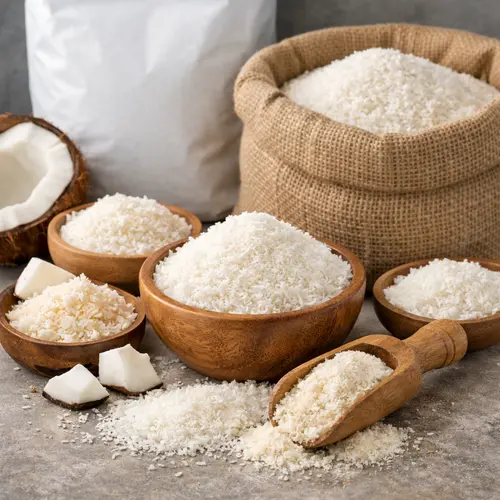
What “fine coconut” is (and why it matters)
Fine coconut is a small-granulation shredded/desiccated coconut designed to distribute evenly in batters, doughs, coatings, and mixes. Compared to medium or flake formats, fine coconut typically offers a smoother bite and more uniform appearance—especially in baked goods.
- Even distribution: helps reduce “clumps” and improves visual consistency.
- Smoother mouthfeel: finer pieces integrate better into batters and fillings.
- Better coatings: improves adhesion on confections and snack coatings.
- Blend-friendly: easier to mix with sugars, cocoa, spices, and powders.
Common coconut spec options (request-based)
Coconut products are often specified by sweetness, fat level, and granulation. If you’re unsure, share the application and we’ll recommend a practical starting spec.
| Option | Typical characteristics | Often used for |
|---|---|---|
| Unsweetened fine | Clean coconut flavor, flexible for savory/sweet; common industrial format. | Bakery, bars, coatings, granola, mixes. |
| Sweetened fine | Sugar-added coconut; improves sweetness and browning in some baked goods. | Cookies, confections, dessert toppings, retail-style bakery. |
| High-fat vs low-fat | Fat level impacts flavor intensity, mouthfeel, and moisture behavior. | Confections, fillings, bakery texture tuning. |
| Toasted (request-based) | Roasted aroma and color; different moisture behavior. | Premium inclusions, toppings, snack mixes. |
Availability varies by origin, certification needs, and packaging. If you need a “bright white” appearance, call that out—whiteness targets can be application-critical.
Common formats (beyond “fine”)
If you’re comparing formats, here’s how teams typically choose based on texture and appearance.
- Fine coconut: smoothest texture, most even distribution.
- Medium coconut: more visible shreds; adds chew and texture.
- Flake: larger pieces for toppings and visual impact.
- Coconut chips: thick, crunchy inclusions and snack mixes.
- Coconut powder/flour (request-based): fine milling for blending and functional uses.
Options & documentation
- Organic and conventional options (where available)
- Kosher options (request current documentation)
- COA & spec sheets for QA and receiving
- Lot traceability and production planning support
- Import / export paperwork support when needed
Documentation availability can vary by origin and format—request current details with your quote.
Specs that matter (what buyers commonly define)
Coconut performance depends on granulation, moisture, and fat. These spec points typically drive how it mixes, bakes, and stores.
| Spec area | Why it matters | How to define it |
|---|---|---|
| Granulation / sieve range | Controls distribution, mouthfeel, and blending behavior. | Target mesh/sieve range; acceptable fines %; “fine vs medium” definitions. |
| Moisture | Affects shelf stability, clumping, and bake texture. | Target moisture range; packaging/liner requirements to protect from humidity. |
| Fat level | Drives richness, aroma intensity, and moisture binding. | High-fat vs reduced-fat specification; application-based preference. |
| Sweetened vs unsweetened | Impacts sweetness, browning, and labeling. | Sweetness preference; target sugar content (if applicable); label requirements. |
| Color / whiteness | Important for coatings and “clean” visual appearance. | Desired color range (bright white vs natural); application needs. |
| Foreign material controls | Critical for ready-to-eat and confectionery applications. | Your QA thresholds; screening/magnet expectations where applicable. |
If you’re coating confections or producing snack mixes, ask about granulation and moisture targets that minimize dusting and improve adhesion.
Common applications
Fine coconut is selected when you want coconut flavor without large visible shreds—or when you need an ingredient that blends smoothly.
Bakery
- Cakes, muffins, cookies, crusts, and fillings
- Even distribution and smoother texture
- Moisture/fat balance impacts tenderness
If you’re switching from sweetened to unsweetened, confirm sugar adjustments and browning expectations.
Coatings & confections
- Chocolate-coated items and snack clusters
- Better adhesion and coverage uniformity
- Color/whiteness matters for appearance
For coatings, humidity control helps preserve texture and reduces clumping.
Bars, granola & mixes
- Better-for-you bars and bites
- Granola clusters and cereal mixes
- Blends with cocoa, spices, and powders
Ask about sieve-defined fines control to reduce dusting during mixing and filling.
Packaging & handling (typical)
Coconut is sensitive to humidity and can pick up odors if stored improperly. Packaging and liners are key for maintaining quality in transit and storage.
- Bulk bags / cartons: common for fine and medium coconut.
- Inner liners: help reduce moisture migration and aroma exposure.
- Case pack planning: supports warehouse handling and production staging.
- Pallet configuration: align with dock constraints and reduce compression.
Storage considerations (general)
Storage needs vary by fat level, moisture, and packaging. Many teams preserve quality by controlling humidity and practicing strong FIFO discipline.
- Humidity control: helps maintain free-flowing texture and reduces clumping.
- Temperature stability: supports aroma and shelf stability.
- Odor management: store away from strong-smelling ingredients.
- FIFO & lot tracking: supports consistent production performance.
For formal storage requirements and shelf-life guidance, rely on the specific documentation and spec sheet for the lot/format you purchase.
How quoting typically works
Coconut quotes move fastest when granulation, fat level, and sweetening requirements are clear—then we align packaging and documentation needs.
- Confirm format: fine coconut (and whether you’re comparing medium/flake/powder).
- Define specs: sieve/mesh range, moisture, fat level, sweetened vs unsweetened, color.
- Share volume & destination: annual usage + delivery region (USA/Canada).
- Finalize packaging: bag/carton weight, liners, pallet constraints.
Spec builder (copy/paste)
Use this template in your quote request to reduce back-and-forth.
Format: fine coconut (desiccated/shredded)
Sweetened? unsweetened • sweetened (target sugar if known)
Fat level: high-fat • reduced-fat (or target % if known)
Granulation / sieve range: (mesh target, acceptable fines %)
Moisture target:
Color / whiteness preference: bright white • natural
Certifications: organic • kosher • other
Packaging: bag/carton weight, liner needs, pallet limits
Annual volume estimate:
Delivery region: USA / Canada (state/province)
If you don’t know granulation, tell us your application (bakery, coating, bar mix) and desired texture and we’ll propose a practical starting sieve range.
Related categories
Browse categories where Fine Coconut is commonly sourced:
Coconut Ingredients Nuts & Seeds Bulk Oils Baking Ingredients
If some category links above don’t exist on your site yet, remove them or replace them with the correct URLs.
Request a quote for Fine Coconut
Share target specs (organic/kosher), sweetened vs unsweetened, fat level, granulation/sieve range, annual volume estimate, and delivery region (USA/Canada). If appearance matters, include a whiteness preference.
For coatings and confections, include your humidity and packaging constraints. For bakery, tell us whether you need a smoother texture or visible shred.
Prefer email? Send your specs to contact@atlastradehouse.com.
FAQ
Do you have minimum order quantities (MOQs)?
MOQs depend on whether you need organic/kosher documentation, sweetened vs unsweetened, fat level, and a specific sieve range or packaging. Share your estimated volume and destination and we’ll confirm MOQ and lead time options.
What’s the difference between fine, medium, and flake coconut?
The difference is primarily particle size. Fine coconut blends more smoothly and distributes evenly; medium coconut is more visible and adds chew; flake is larger and used for toppings and strong visual impact. If you share your application, we can recommend the best fit.
Do you supply sweetened and unsweetened fine coconut?
Often yes, depending on specs and volume. Tell us your labeling needs and whether you require a specific sugar target.
How do I specify granulation?
Many buyers specify granulation using a sieve/mesh range and acceptable fines percentage. If you don’t have a number, describe your desired texture (smooth vs visible shred) and your process (coating, baking, mixing) and we’ll propose a starting spec.
What documentation can you provide?
Documentation may include COAs, spec sheets, allergen statements, and lot traceability. Import/export support is available when needed. Availability varies by origin and format—request current details with your quote.
For formal storage requirements and shelf-life guidance, rely on the specific documentation and spec sheet for your requested lot/format.