Home / Products / Freeze-Dried Vegetables & Herbs / Cauliflower
Wholesale ingredient • Documentation support • Custom processing
Cauliflower
Wholesale supply for Cauliflower with consistent specs, food safety documentation, and flexible formats for USA & Canada buyers—often sourced in freeze-dried formats for soups, instant meals, seasoning blends, snack mixes, and vegetable-forward formulations where quick rehydration and stable shelf life are important.
Note: “Cauliflower” in this category typically refers to freeze-dried cauliflower formats. If you need air-dried or dehydrated options instead, mention it in your quote request.
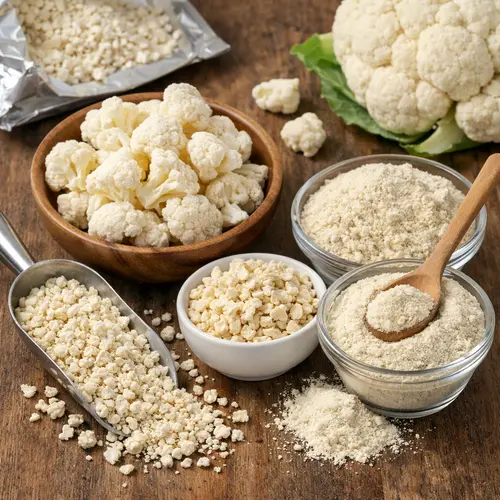
Why teams use cauliflower in shelf-stable products
Cauliflower is a versatile, mild-tasting vegetable that supports vegetable-forward positioning without dominating flavor systems. In freeze-dried form, it offers quick hydration and a light structure that works well in soups, meal kits, and dry blends.
- Mild flavor: pairs with herbs, spices, dairy-style powders, and savory bases.
- Quick rehydration: suitable for instant cups and hot-water applications.
- Texture contribution: adds vegetable presence without heavy density.
- Blend-friendly: available in sizes that match other vegetables to reduce separation.
Format selection (how buyers typically choose)
Choose a format based on how the product is prepared and what consumers should see in the finished bowl/cup.
| Format | Typical characteristics | Often used for |
|---|---|---|
| Florets | Largest pieces; strong visual presence; may be more fragile in transit. | Premium soup mixes, meal kits, visible vegetable blends. |
| Dices | Uniform pieces; easier to blend with other vegetables. | Soups, instant meals, side dishes, dry blends. |
| Granules | Smaller cut; more even distribution; faster hydration. | Seasoning blends, sauces, savory bases, snacks. |
| Powder | Fine milling; integrates smoothly; contributes flavor and body. | Seasonings, soups, sauces, extrusion or snack coatings. |
If you need a “quick cup” product, specify your hydration time target (e.g., 3–5 minutes) so we can recommend a cut size that hydrates fast enough.
Common formats
Most buyers specify cauliflower by cut size and fines. We can help align a format to your process and blend partners.
- Freeze-dried florets: visual impact; best for premium blends.
- Freeze-dried diced: uniform size; easier blending with other vegetables.
- Freeze-dried granules: quick hydration; good for seasoning or soup bases.
- Powder: consistent integration; supports flavor and body in dry mixes.
- Custom sieve fractions (request-based): “through/on” ranges to control distribution.
Options & documentation
- Organic and conventional options (where available)
- Kosher options (request current documentation)
- COA & spec sheets for QA and receiving
- Lot traceability for production planning
- Import / export paperwork support when needed
Documentation availability can vary by origin and format—request current details with your quote.
Specs that matter (what buyers commonly define)
Freeze-dried vegetables are often purchased for consistent appearance and predictable hydration. These spec points typically drive quality outcomes.
| Spec area | Why it matters | How to define it |
|---|---|---|
| Cut size & sieve range | Controls blend uniformity and serving-to-serving distribution. | Nominal size (floret/dice/granule) + “through/on” sieve range. |
| Fines percentage | Excess fines can dust, settle, or change flavor intensity. | Acceptable fines %; packaging controls to reduce breakage. |
| Moisture | Affects shelf stability and texture retention. | Target moisture range; liner requirements; humidity controls. |
| Rehydration time | Critical for instant cups and quick-prep meals. | Target time (e.g., 3–5 minutes) and temperature (hot water vs simmer). |
| Color/appearance | Impacts finished bowl aesthetics and perceived freshness. | Appearance expectations; allowed natural variability by lot. |
| Foreign material controls | Important for ready-to-eat applications and audits. | Your QA thresholds; screening/magnet expectations where applicable. |
If you’re building a multi-vegetable blend, send the specs for your other vegetables and we can recommend a cauliflower cut size that matches to reduce segregation.
Common applications
Cauliflower works well across savory categories because it’s mild and blends easily with herbs, spices, and dairy-style flavors. Below are common applications and what teams usually prioritize.
Soups & instant meals
- Diced or granules for quick hydration
- Consistent cut size to match other vegetables
- Fines control for clean bowls and consistent flavor
For instant cups, specify your prep time and water temperature for the best match.
Seasonings & savory bases
- Powder or fine granules for even blending
- Flowability and dusting considerations
- Flavor intensity targets for repeatable results
If you blend with salt/spices, ask about anti-caking strategies and particle size alignment.
Snacks & coatings
- Powder for seasoning blends and coatings
- Granules for texture-forward coatings
- Moisture control for crispness and shelf stability
Tell us if you need a very fine powder (smoother) or a coarser powder (more texture).
Packaging & handling (typical)
Freeze-dried vegetables are lightweight and can be fragile. Packaging and pallet configuration can significantly impact fines generation and delivered appearance.
- Bulk cartons with liners: common for pieces and granules.
- Smaller case packs: can reduce compression for delicate florets.
- Pallet configuration: helps minimize crushing in transit.
- Moisture barriers: liners help protect against humidity exposure.
Storage considerations (general)
Freeze-dried formats are sensitive to humidity. Storage practices help preserve texture and reduce clumping.
- Humidity control: protects crisp structure and prevents softening.
- Temperature stability: supports shelf-life and consistent performance.
- FIFO & lot tracking: keeps production consistent from run to run.
- Seal integrity: ensure liners/bags are closed properly after partial use.
For formal storage requirements and shelf-life guidance, rely on the specific documentation and spec sheet for the lot/format you purchase.
How quoting typically works
Quotes move fastest when you specify the format, cut size, and how quickly the cauliflower must hydrate in your application.
- Choose a format: florets, diced, granules, powder.
- Define specs: sieve range, fines %, moisture, rehydration expectations.
- Share volume & destination: annual usage + delivery region (USA/Canada).
- Confirm packaging: case pack/liner needs, pallet constraints, breakage sensitivity.
Spec builder (copy/paste)
Use this template in your quote request to reduce back-and-forth.
Format: freeze-dried florets • diced • granules • powder
Target cut size / sieve range:
Acceptable fines %:
Rehydration target: time + temperature (e.g., 4 min in hot water)
Certifications: organic • kosher • other
Allergen needs (declare/avoid):
Packaging: case pack, liner needs, pallet limits
Annual volume estimate:
Delivery region: USA / Canada (state/province)
If you don’t know sieve ranges, tell us your application (instant soup, seasoning powder, meal kit) and your target hydration time.
Related categories
Browse categories where Cauliflower is commonly sourced:
Freeze-Dried Vegetables & Herbs Freeze Dried Vegetable Powders Soups & Meal Mixes
If some category links above don’t exist on your site yet, remove them or replace them with the correct URLs.
Request a quote for Cauliflower
Share target specs (organic/kosher), format (florets/diced/granules/powder), annual volume estimate, and delivery region (USA/Canada). For instant products, include your target rehydration time.
For blends, include your other vegetable cut sizes so we can recommend a matching cauliflower size for better uniformity.
Prefer email? Send your specs to contact@atlastradehouse.com.
FAQ
Do you have minimum order quantities (MOQs)?
MOQs depend on format (florets/diced/granules/powder), documentation needs (organic/kosher), and packaging. Share your volume and destination and we’ll confirm MOQ and lead time options.
Which cut size is best for instant soups?
Many instant soups use diced or granules to meet short hydration times. If you share your prep instructions (time and water temperature), we can recommend a cut size that hydrates fast enough while still providing visible vegetable presence.
Is cauliflower powder good for seasoning blends?
Often yes. Powder can add savory vegetable notes and body, but the best mesh depends on your blend and dusting tolerance. Tell us whether you need a very fine powder or a slightly coarser grind for texture.
Do you offer organic or kosher options?
Options may be available depending on origin and format. Request current documentation requirements with your quote so we can confirm feasibility and lead times.
What documentation can you provide?
Documentation may include COAs, spec sheets, allergen statements, and lot traceability. Import/export support is available when needed. Availability varies by origin and format—request current details with your quote.
For formal storage requirements and shelf-life guidance, rely on the specific documentation and spec sheet for your requested lot/format.