Home / Products / Freeze-Dried Vegetables & Herbs / Broccoli
Wholesale ingredient • Documentation support • Custom processing
Broccoli
Wholesale supply for Broccoli with consistent specs, documentation support, and flexible formats for USA & Canada buyers—ideal for soup mixes, meal kits, seasoning blends, and prepared foods.
Quick purchasing checklist
- Processing: freeze-dried (fast rehydration, color retention) or dehydrated (cost-efficient)
- Format: florets, chopped pieces, granules, or powder
- Cut size: target size range + sieve distribution for blending and portion consistency
- Rehydration target: desired texture after hydration (bite vs. soft)
- Specs: moisture / water activity, micro criteria, foreign material controls
- Certifications: organic and/or kosher requirements
- Volume: R&D trial, monthly demand, annual forecast
- Destination: USA/Canada delivery location and receiving constraints
- Documentation: COA/spec/allergen/traceability package for onboarding
About this ingredient
Broccoli is widely used in savory products where you want recognizable vegetable identity, green color cues, and balanced vegetal flavor. In manufacturing, broccoli is commonly sourced in freeze-dried or dehydrated formats to increase shelf life, simplify handling, and enable predictable rehydration in-process.
Buyers typically define broccoli ingredients by cut type (florets vs. stems vs. chopped), cut size, rehydration performance, and technical specs like moisture/water activity, foreign material controls, and microbial criteria.
- Flavor: mild green vegetal; sensitive to processing and storage odors
- Function: texture and vegetable identity in soups, bowls, and meal kits
- Operational value: stable, blendable, and scalable for high-volume programs
Why source broccoli wholesale through Atlas?
We help procurement and R&D teams match broccoli formats to product needs—cut sizing for blend uniformity, rehydration behavior for texture targets, and documentation support for QA onboarding.
- Format guidance: freeze-dried vs. dehydrated based on texture, color, and cost goals
- Sizing support: sieve ranges and fines control to reduce dust and improve flow
- Documentation support: COA/spec sheets + lot traceability where available
- USA & Canada buyers: procurement-friendly sourcing and logistics coordination
Documentation availability can vary by origin and format—request current details with your quote.
Common formats (freeze-dried or dehydrated)
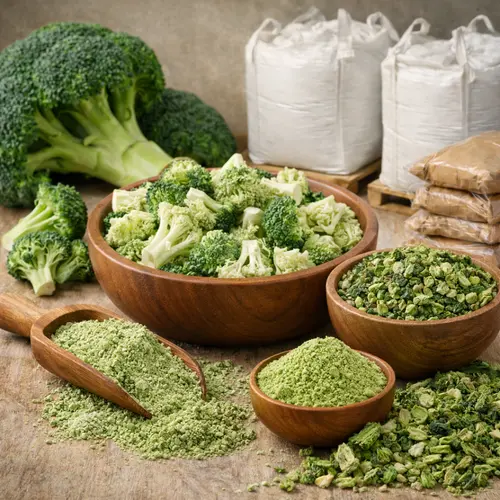
Format choice depends on your application and how visible you want broccoli to be in the finished product. Florets deliver the strongest visual cue. Pieces and granules provide consistent distribution. Powder supports fast dispersion in bases.
Small florets
- Highest “real vegetable” appearance
- Best for premium soup and meal kit applications
- Specify size range to reduce variability
Best for: cup soups, meal kits, vegetable-forward blends.
Chopped pieces
- Improved blending stability vs. larger florets
- More uniform rehydration in some systems
- Good balance of visibility and consistency
Best for: soups, prepared foods, fillings, sauces.
Granules
- Uniform distribution in seasoning and dry mixes
- Reduces segregation when matched to other particles
- Useful where visual floret identity isn’t required
Best for: savory blends, bouillon-style bases, premixes.
Powder (when available)
- Fast dispersion and consistent dosing
- Specify mesh/sieve for flow and mouthfeel
- Useful in vegetable bases and functional blends
Best for: sauces, soup bases, seasoning systems, blends.
Custom cut / sieve
- Target cut sizes to match other inclusions
- Fines control for dust and flow improvement
- Better repeatability for co-packer runs
Best for: multi-ingredient blends and private label programs.
Blends (where supported)
- Pair with carrot, onion, celery, herbs
- Align particle size to reduce segregation
- Simplify sourcing for soup and meal kit SKUs
Best for: soup mixes, meal kits, seasoning blends.
Need a specific cut size, sieve distribution, or rehydration target? Tell us what you’re making and we’ll match an option.
Typical specifications buyers request
Specifications vary by processing type and supplier. Below are common procurement and QA data points for broccoli ingredients.
- Processing type: freeze-dried vs. dehydrated
- Cut type: florets vs. chopped vs. granules vs. powder
- Particle sizing: cut size range + sieve distribution targets
- Moisture / water activity: critical for shelf stability and flow properties
- Color: appearance targets for visible inclusions
- Sensory: aroma and flavor targets; off-note tolerance
- Foreign material control: screening and metal detection where applicable
- Micro profile: standard ingredient microbial criteria where available
- Documentation: COA/spec sheets + traceability where available
Handling & storage notes
Dried and freeze-dried vegetables are humidity sensitive. Moisture pickup can cause softening, clumping, and reduced flowability.
- Storage: cool, dry conditions; reseal after opening
- Humidity management: stage only what you need for a run to limit exposure
- Odor control: store away from strong spices/chemicals
- Blend performance: match particle sizes to reduce segregation and dust
If texture after rehydration is critical, share your process temperature and hydration time window for better matching.
Applications & process notes
Broccoli is used across savory mixes and prepared foods where you want vegetable identity without fresh handling complexity. Below are common uses and selection tips.
Soup mixes & cup soups
- Florets/pieces for visible vegetable identity
- Granules/powder for base flavor support
- Specify rehydration behavior for target texture
Prepared meals
- Entrées, bowls, meal kits
- Focus on bite/texture after heating
- Choose cut size that matches portion expectations
Seasoning blends
- Granules/powder for uniform distribution
- Mesh impacts adhesion and mouthfeel
- Fines control improves flow and reduces dust
Sauces & bases
- Powder for fast dispersion and dosing
- Build vegetable character in savory bases
- Confirm dispersion needs in your liquid phase
Dry meal kits
- Reduce cold-chain complexity
- Align particle size to avoid segregation
- Use blends to simplify sourcing
R&D trials
- Compare freeze-dried vs. dehydrated for texture
- Test sizing in your packaging for segregation
- Lock a spec for scale-up repeatability
Options & documentation
- Ask for organic, kosher, and custom processing options
- COA and spec sheets for QA onboarding and receiving
- Lot traceability support where available
- Support for import/export paperwork when needed
- Private label support depending on program and volume
Documentation availability can vary by origin and format—request current details with your quote.
Packaging & logistics notes
Packaging depends on format. Freeze-dried items typically require strong moisture barriers; dehydrated products require humidity protection and crush resistance.
- Bulk packaging: cartons or bags (varies by format)
- Moisture protection: critical to preserve texture and prevent clumping
- Palletization: improves receiving and reduces damage
- Lead times: vary by format and seasonality—request current availability
For consistent reorders, share your forecast and preferred cut size so we can align supply planning.
Quality approach (production-ready sourcing)
We help you choose broccoli specs that fit your line: flow and blending properties, consistent inclusion size, and documentation support for onboarding. If you’re scaling a soup mix or meal kit, small spec differences can impact yield and rework.
Spec alignment
Cut size, sieve distribution, moisture/aw and sensory targets aligned to your application.
Documentation support
COA/spec/allergen/traceability items typically requested for vendor onboarding and receiving QC.
Repeatability
Reorder-ready specs that reduce variability across batches and co-packer runs.
FAQ
Do you have minimum order quantities (MOQs)?
MOQs depend on processing type (freeze-dried vs. dehydrated), cut size, certifications, and packaging. Send your target volume and destination (USA/Canada) and we’ll confirm options.
Is this freeze-dried or dehydrated broccoli?
Availability may include freeze-dried and/or dehydrated formats. Freeze-dried is often chosen for faster rehydration and better color retention; dehydrated is commonly chosen for cost efficiency.
Do you offer florets, pieces, and powder?
Yes—depending on availability. Common formats include small florets, chopped pieces, granules, and powder. Share your target cut size or sieve range and we’ll match an option.
Can I request organic and kosher options?
Where available, we can provide organic and/or kosher options along with the documentation needed for your program.
What documentation can you provide?
Common documentation includes a COA, specification sheet, allergen statement, and country of origin. Additional documents may be available upon request depending on the lot and format.
Related categories
Browse categories where this ingredient is commonly sourced:
Freeze-Dried Vegetables & Herbs Dehydrated Vegetables Spices & Seasonings
Request a quote for Broccoli
Share target specs (organic/kosher), processing preference (freeze-dried or dehydrated), cut size/sieve range, estimated annual volume, and delivery region (USA/Canada). If you have an internal spec sheet, include it for faster matching.
What to include
- Company name + application (soup mix, meal kit, seasoning, prepared foods)
- Processing type (freeze-dried vs. dehydrated)
- Cut size (florets/pieces/granules/powder) + sieve targets
- Estimated quantity (trial, monthly, annual)
- Delivery city/state/province + receiving constraints
- Documentation requirements (COA/spec/allergen/traceability)
What you’ll get back
- Matched format options and current availability
- Documentation packet for QA onboarding
- Lead time + logistics guidance
- Reorder-ready spec alignment for repeat runs
Ready to start? Use the quote form and include as many details as possible.
Notes for QA & labeling teams
Availability, certifications, and documentation vary by origin and supplier. Confirm final specifications, labeling claims, and moisture/water activity requirements for your exact format before production and packaging approval.